
It taken me a lot of years to learn to handle my stress levels. Good mental health depends on so many factors. One of them is managing our stress. How we handle stress depends on the thoughts we allow into our minds and how much we entertain and act on them.
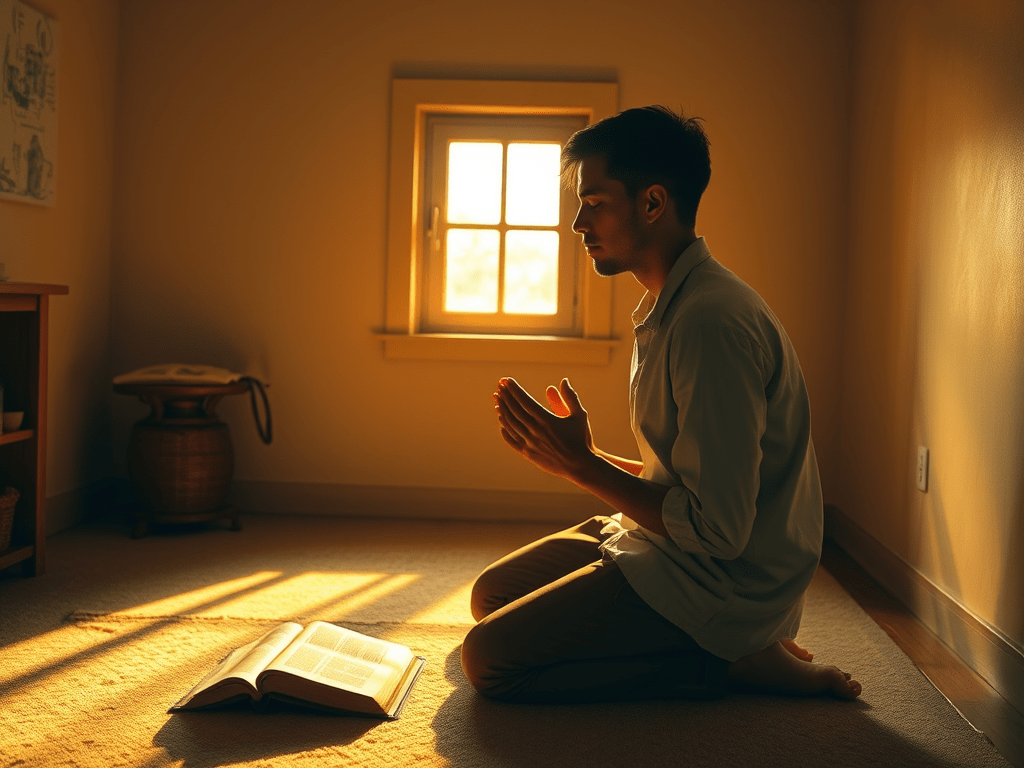
Contemplative prayer not only connects us with God but also has a positive effect on our mental health, becuase it relieves stress.
In this article, I briefly share and outline the theology of mental health and how Jesus practised contemplative prayer.
Now, Jesus was both human and divine. We see in the scriptures under tremendous stress, for example, in the Garden of Gethsemane, when he was under extreme stress, that he sweated blood before going to the cross.
We see him in tears as he wept over Jerusalem. I’m sure contemplation served several purposes for the human Jesus. Served to the divine nature of Jesus as well. Thank you for being here. If this topic interests you, keep reading.
Blogging regularly can be tricky because creating themes takes time and effort. I’ve been writing for quite a while, and the good news is that I have developed a prayer routine and a writing rhythm that keep me on track. However, my home is in a 12-month renovation period. The upset of builders coming and going is pulling me from my routine, which is stressful enough, but the pull from Protestantism to Catholicism is added to that.
A few times, I have been writing in my local pub away from the chaos of the building work. I sit down and enjoy breakfast and coffee, then get to work. Until now, I have only done this now and then, but I want to form the habit of doing it more often. Writing in a pub draws conversation and curiosity when I tell people I am writing a sermon. I intend to share the Love of Jesus with anyone who is interested.
I am not the best writer in the world, as I am dyslexic, but I do my best. But I hope to get my ideas across clearly and succinctly. What do you think? Where can I improve? Let me know in the comments.
Earlier this year, I led a quiet retreat day in my area on how mindfulness helps with contemplative prayer.
The Theology of Mindfulness
Our minds get busy as we absorb outside chatter, which can assault our ears and minds, causing us a certain amount of stress. We also contend with inner chatter, which we sometimes fail to turn off, preventing us from resting or sleeping.
Developing the mindfulness habit will help us control the external and internal chatter, giving us back control of our thought life.
Although you will not find the word ‘mindfulness’ in the Holy Scriptures because it’s a modern word, you will find it in principle in both the Hebrew Scriptures (Old Testament) and the New Testament. Let’s briefly look at the theology of mindfulness.
Jesus the Contemplative
Jesus was a contemplative… and the best teacher of contemplation! Jesus is the expert and our very source of contemplation. Western Christianity historically identifies more with action than with contemplation, and though action is meaningful, action cannot reach its full fruition without contemplation. Contemplative prayer involves:
- Interiority: going into “our inner room” (Mt 6:6)
- Silence: prayer is about brevity, simplicity, and trust
- Calmness: freedom from anxiety and obsession with material things
- Mindfulness: focusing on God’s Kingdom before all else
- In the Now: living in the present moment, free from fear of the future.
Contemplation is “a path, an experience, a lifelong practice, an expansion and deepening of consciousness. Recovering the elements of contemplation is crucial to our relationship with Christ, with others, and to the recognition of the Divine Presence in all of creation.
Contemplative orders recognise this reality and that contemplation is not about the solitary but community, not about an enthusiasm to change but a capacity to coexist in search of wisdom – a solidarity with all creation. Turning to Christ as the teacher of contemplation, we can understand the wisdom imparted for us all to discover.
I attend Adoration of the Holy Sacrament each week. During this time, contemplation comes to the fore as I sit for 90 minutes adoring and pondering upon Christ Himself within the Host.
What does the Bible Say?
As evidence of Christ’s contemplative nature, we certainly can point to the various times Jesus leaves to pray either alone or with a few of his disciples (e.g., Lk 6:12, 9:18, 22:39), teaching us that “religion without contemplation lacks an essential part of holiness.
Are we just going through the motions of our faith – attending weekly Church services, saying prayers, and volunteering to help the poor? Or do we do those things fully intending to represent Jesus on earth in all our doing?
Without a contemplative dimension to our lives, we get so far and miss the target of taking the heart of Jesus’ message of love and care for all.
Jesus teaches us more than “go into your inner room, shut your door, and pray to your Father in secret” (Mt 6:6). He tells us to put our prayers into action and show the world His divine mercy. Contemplation and action together are imperative to our spiritual life.
As good spiritual directors know, asking the right question (without offering answers) opens an individual to fruitful contemplation and reflection.
Jesus uses this ‘open question’ technique, asking, “Who do you say that I am?” (Mk 8:29, Mt 16:15). This question, so personal, so direct, carries us into the contemplative dimension. Like Peter, we are tempted to give the set “correct” answer, and so we miss Jesus’ point that there is no “correct” or “incorrect” answer.
Contemplation helps you find your answer. Jesus, the ultimate paradox, helps us hold contradictions and see the way to God’s Kingdom by letting go of the love of power and control and then replacing it with forgiveness, compassion, solidarity with others, humility, and wisdom.
Jesus is our contemplative teacher. Jesus knows how to ask questions, challenge, and lead us to the Kingdom. We have to pay attention to the question in the questioning.
Mary & Martha
Jesus also shows us how to bring contemplation and action together. If we turn to the story of the two sisters, Martha and Mary (Lk 10:38-42), we find that they symbolise action and contemplation, respectively.
Mary and Martha typify the two halves of our soul.
As Jesus visits, Martha is the one scurrying around (like so many of us do daily), stressed over the many tasks to prepare for her guests.
On the other hand, Mary is sitting at Jesus’ feet, listening attentively to his every word. Perhaps more shocking than Martha’s telling Jesus what to do, she says, “Tell her to help me.”
Jesus calmly replied, “Mary has chosen the better part.” (Lk 10:42). Martha forgets that Mary is also working. She’s working on being still and listening while building her faith. Here, Jesus is teaching us the supremacy of contemplation over action.
Jesus is pointing out that our priority should be the eternal Kingdom’s business, not this temporal Kingdom’s.
Contemplation helps move us beyond our egos and self-importance. Balancing our non-action and action is not easy, but our wholeness depends on it (Lord, forgive the things I fail to do).
We must have a deep sense of who we are in Christ before our actions align with Christ’s.
Like Jesus, the perfect example of the harmony between action and contemplation is to seek to withdraw from time to time to pray and contemplate. In this way, we must pay attention to daily prayer and devotions, weekly worship, and ensure you attend other prayer meetings your parish offers.
Balance is the Key to Growing in Christ
Though achieving the proper equilibrium is difficult, Jesus shows us how to balance action and contemplation. Jesus shows us how to express non-violence, show compassion, and live in the divine image in which God made us.
Through Jesus, God de-legalised sin. However, associating it with grace and forgiveness does not exclude punishment for sin. Taking responsibility for our sins transforms our inner quest, transforming the outward reality.
In teaching us contemplation, Jesus gives us the means of seeing God in each person and throughout creation. He gives us the means to “not be afraid” despite conflict, anxiety, and obsessions.
Jesus teaches us how to live in the present moment, balancing contemplation and action – living a peaceful, contemplative life.
☕ If you’d like to support what I am doing: Buy Me a Coffee. If you find my videos & writing inspiring and uplifting, consider supporting what I do. Buy me a coffee. Your support makes a difference in my life and helps me create more of what you and I like. Thank you
For Inspirational Videos Click HERE
I’m Paula Rose Parish — a former atheist of 21 years, Protestant pastor for over 40 years, and now a Catholic convert. After a powerful encounter where Jesus audibly called me to follow Him, my life was forever changed. I’ve ministered across Australia, the USA, and the UK, and today, I share my journey of faith, hope, and transformation.
This is a place for seekers, converts, reverts, and the curious. Here, you’ll find honest conversations about Catholicism, personal testimony, theological insight, and encouragement for those walking toward (or wondering about) the Catholic Church.
🕊️ From Atheism to Faith. From Pastor to Catholic.
📖 Read my blog: www.almostcatholic.blog
🌿For Free Holistic Well-being Resources www.paularoseparish.org
And Videos- YouTube https://www.youtube.com/channel/UCvdQ4NPTNfXSnwd3pimPh0g
🕊️You can also find all my Books by following the links to Amazon.com or Amazon.co.uk
🙏 Subscribe, like, and share if you find something meaningful here.
Jesus loves you — and He’s calling you home. Welcome to the journey. 💕✝️
Contact by Email: paularoseparish@gmail.com
If you are struggling to find non-judgmental advice or support, please feel free to contact me. If you are grieving and need to talk or seek spiritual help, drop me an email to chat with me.
In the comments section, I would love for you to share your faith stories and comments with this community.
We seek to foster a sense of community. All blog posts are here for your encouragement and to share with others. You will find various topics relevant to faith and wellness in everyday life.
Copyright © 2024. Paula Rose Parish. All Rights Reserved


Thanks for your Visit Here, feel free to leave a comment 💟