
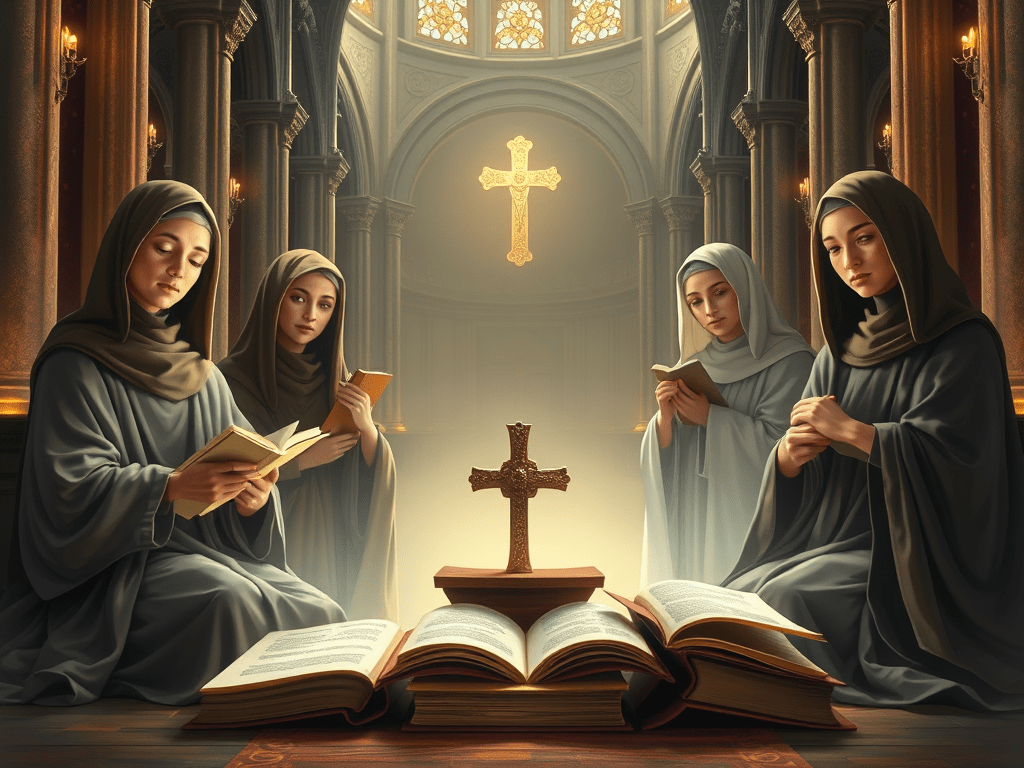
What Is a Doctor of the Church?
There are four women recognised as Doctors of the Catholic Church, a title signifying their immense contribution to theology and doctrine through study, writing, and, in some cases, mystical experience. They are St. Teresa of Ávila, St. Catherine of Siena, St. Thérèse of Lisieux, and St. Hildegard of Bingen.
The recognition that women had always been profound teachers in the Church, sometimes overlooked, sometimes unheard, but never absent. Their inclusion did not change the meaning of the title. It revealed the full breadth of God’s work among His people.
As a former Protestant, I never encountered anything like the “Doctors of the Church,” largely because Protestantism comprises thousands of denominations, each with its own authorities, theological emphases, and governance structures. No single body exists to universally recognise particular teachers as having a definitive influence on doctrine for all Protestants.
The Catholic Church, however, is fundamentally different. She understands herself to be one, visible Church under a unified teaching authority: the Magisterium. Within this framework, the Church can formally recognise certain saints whose theological insight, holiness, and fidelity have profoundly shaped the Church’s understanding of the faith. These are named Doctors of the Church—not as independent authorities, but as exemplary witnesses whose writings and teaching have served the development and clarification of doctrine in communion with the Church’s living tradition.
The Catholic Church has always been a teacher. From the apostles to the present day, the faith has been handed on through preaching, writing, witness, and sacrifice. Yet among the countless saints who have lived holy lives, only a small number are given the unique title of Doctor of the Church.
This title does not refer to medicine, nor is it a symbol of academic achievement alone. It is the Church’s recognition that a person’s life and teaching illuminate the Gospel in an extraordinary and enduring way for all generations.
To understand the four female Doctors of the Church, we must first understand what this title means and why it matters so deeply for the Church, and especially for women today.
A Title Rooted in Teaching and Holiness
The word “doctor” comes from the Latin docere, meaning “to teach.” A Doctor of the Church is someone whose teaching has helped shape the understanding of the faith in a lasting, universal way. The Church names a saint a Doctor only after careful discernment. Traditionally, three elements are present:
1. Eminent holiness
Their lives reflect a profound union with God. Their teaching flows not merely from intellect but from sanctity.
2. Orthodoxy of doctrine
Their writings are faithful to the truth of the Gospel and the Church’s teaching.
3. Lasting contribution to theology or spiritual life
Their insights continue to guide believers across centuries and cultures.
This is not an honorary title. It is a recognition that the Holy Spirit has spoken powerfully through this person for the sake of the entire Church.
Doctors are not perfect. They struggled, doubted, suffered, and sometimes lived in confusing or turbulent times. Yet through these experiences, their witness became clearer, not weaker. Their authority comes from their fidelity to Christ.


Thanks for your Visit Here, feel free to leave a comment 💟