
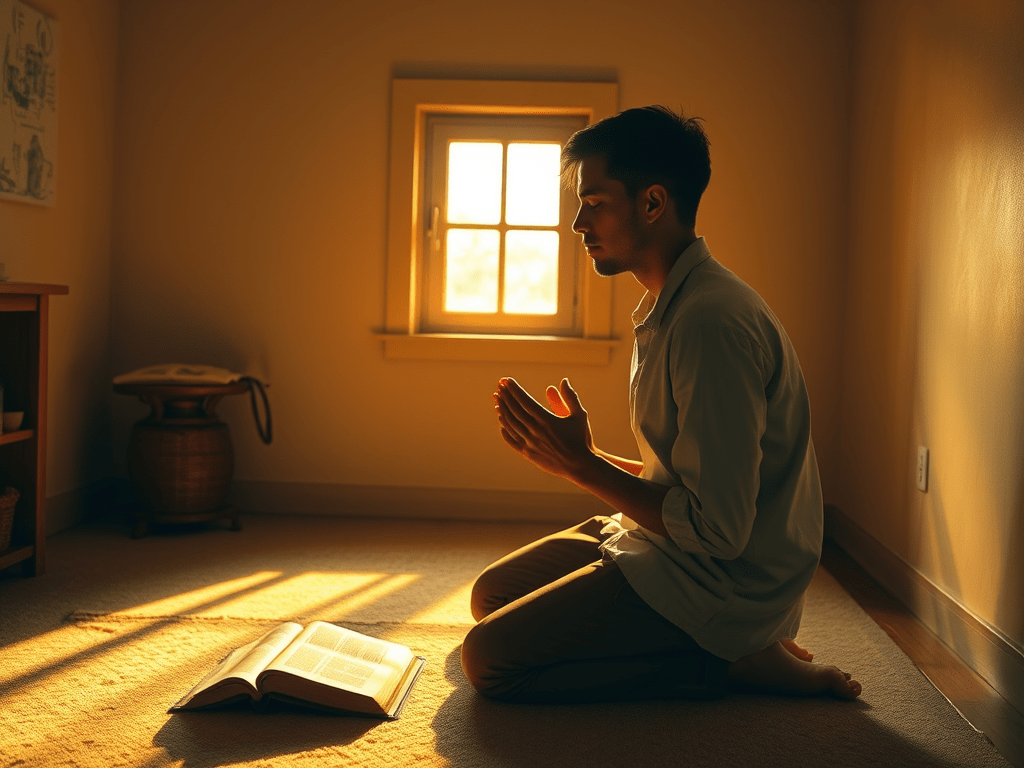
Summary: How do we start our prayers? Do we need to acknowledge who we are addressing? Do we come with gratitude, reverence, and awe, or do we barge with demands?
Scripture: Psalms 119:12–56, Matthew 6:5–9
“And when you pray, do not be like the hypocrites, for they love to pray standing in the synagogues and on the street corners to be seen by others.
Honestly, they have received their full reward. But when you pray, go into your room, close the door and pray to your unseen Father. Then your father, who sees what is done secretly, will reward you.
The Science of Prayer
Below is a direct quote for scientific research, which is cited HERE.
“Prayer is also hard to study, Dr. Rosmarin says. To measure its impact, researchers need to find people who are open to praying but don’t already do it, which isn’t easy. Brain scans are difficult because people often pray out loud and don’t typically stay still when they pray, unlike when they meditate. And prayer is only likely to have mental-health benefits for those who are open to it.
“I would never advise a patient who doesn’t want to pray to pray,” says Dr Rosmarin, who incorporates prayer into the treatment programs for some patients with anxiety, depression or other mental-health conditions. He tells people curious about prayer to imagine a heart-to-heart conversation with someone they haven’t spoken to in a while. “If you think, ‘Yeah, I should probably pick up the phone but am not sure what to say,’ then it might help.”
Dr. Rosmarin says that the research that has been done on prayer shows it may have similar benefits to meditation: It can calm your nervous system, shutting down your fight or flight response. It can make you less reactive to negative emotions and less prone to anger.
A 2005 study in the Journal of Behavioural Medicine comparing secular and spiritual forms of meditation found that spiritual meditation was more calming. In secular meditation, you focus on something such as your breath or a nonspiritual word. In spiritual meditation, you focus on a spiritual word or text. Participants were divided into groups, with some taught to meditate using words of self-affirmation (“I am love”) and others taught to meditate with words that described a higher power (“God is love”). They then meditated for 20 minutes a day for four weeks.
Researchers found that the group that practised spiritual meditation showed greater decreases in anxiety and stress and a more positive mood. They also tolerated pain for almost twice as long when asked to put their hand in an ice-water bath.
Some scientists who study prayer believe that people who pray benefit from a sense of emotional support. Imagine carrying a backpack hour after hour. It will start to feel impossibly heavy. But if you can hand it off to someone else to hold for a while, it will feel lighter when you pick it up again.
“This is what prayer can do,” says Amy Wachholtz, associate professor and clinical health psychology director at the University of Colorado Denver, and lead researcher on the meditation study. “It lets you put down your burden mentally for a bit and rest.”
Prayer can also foster a sense of connection — with a higher power, your environment and other people, including “the generations of people who have prayed before you,” says Kevin Ladd, a psychologist and director of the Social Psychology of Religion Lab at Indiana University South Bend.
People pray for many reasons, including for guidance, thanksgiving, solace or protection. But not all prayer is created equal, experts say.
A 2004 study on religious coping methods in the Journal of Health Psychology found that people who approach God as a partner or collaborator. Those who have better mental and physical health outcomes in their lives.
Prayer can also help your marriage, according to several studies at Florida State University in Tallahassee. Researchers there have found that when people pray for their spouse’s well-being during a negative emotion in the marriage, both partners . The one praying and the one being prayed for report greater relationship satisfaction.
“Prayer gives couples a chance to calm down,” says Frank Fincham, eminent scholar in the College of Human Sciences at Florida State University, who conducted the studies. “And it reinforces the idea that you are on the same team.”
The Theology of Prayer
Read Matthew 6:5–9. And when you pray, do not keep babbling like pagans, for they think they will be heard because of their many words. 8 Do not be like them, for your Father knows what you need before you ask Him.
“This, then, is how you should pray: ‘Our Father in heaven,
hallowed be Your name. ‘” Do you notice how this prayer starts?
It has two purposes….
1) It is directed to God the Father
2) It starts with worship of the Father
Read Psalm 119:12–56. Psalm 119 helps us pray as we explore its commonalities with the Lord’s Prayer.
First of all, the entire Psalm is a prayer! We are taught through this prayer, but it is one long prayer!
Who is this prayer being prayed to?
It is being prayed to the LORD, Yahweh, the God of Israel!
Psalm 119 verse:
64 — “The earth is filled with Your love, LORD … “
68 — “You are good, and what you do is good …”
90 — “Your faithfulness continues through all generations …”
137 — “You are righteous, LORD …”
156 — “Your compassion, LORD, is great …”
David refers to the Lord by name or God at least 20 times and to the Lord with the pronouns You or Yours dozens of times!
You will find that every prayer in the Old Testament is prayed to Yahweh, the LORD, the God of Israel!
And every prayer in the New Testament with an actual text of the prayer is being addressed to God the Father.
That is why, in Psalm 119, David constantly seeks the Lord; in the pattern Jesus gave us to pray, He starts with “Our Father”.
And based on what we find in the Bible, we only pray to God.
So, the example Jesus gave the disciples starts with “Our Father”. What does it say next?
“Hallowed by Thy name” …………………. in other words
May Your name always be kept holy …Let Your name remain holy …
What is Jesus teaching us here? He is teaching us that when we pray to the Father, we should also start our prayers with worship!
The Lord knows our needs and our requests.
Starting our prayers with worship orients our hearts with God.
Starting our prayers with worship puts us in a posture of humility, keeping the proper perspective: He is God; we are not.
We do not make demands; we make requests that hinge upon His will, not ours.
Did David use worship in his prayer to the Lord, as recorded in Psalm 119? Let’s look at the same verses …
12 — “Praise be to You, LORD …”
64 — “The earth is filled with Your love, LORD … “
68 — “You are good, and what You do is good …”
90 — “Your faithfulness continues through all generations …”
137 — “You are righteous, LORD …”
156 — “Your compassion, LORD, is great …”
David says in his prayer that the Lord is to be praised; He is the source of love, He is good, He is faithful, He is righteous, and He is compassionate!
When we pray, we should follow the pattern of the Lord’s prayer and the example found in Psalm 119.
Worship can be very hard if you only know about the Lord but do not know Him.
Do you know how easy it is to praise someone you love?
What’s hard is trying to worship God when you don’t know Him.
How can we come to know the Lord intimately so that praise and worship become natural?
Here are some Tips that will help answer that Question.
· Read and meditate upon His Word.
· Obey Him and find out that He is totally trustworthy.
· Find worship music that speaks of the wonder of God.
· REALLY know Jesus as your Saviour.
· Is the Lord God indeed your Father who is in Heaven?
· Is He so dear to you that you want to keep His name holy?
· Is His name a treasure in your heart?
You may have said the “sinner’s prayer,” but without a life of commitment, they are just empty words.
If you know Jesus as your Lord (Master, Ruler) of your life and if you feel the Holy Spirit drawing you to the Word and to pray. Then you are spiritually positioned so that worship should be natural for you, not forced.
But if Jesus is like the medical kit you keep on the shelf for when you get a cut, or like the spare tyre in your car that you only haul out when you are stranded, true worship will be non-existent in your life.
If so, I suggest we follow the pattern Jesus gave us and begin our prayers, acknowledging the Father and giving Him the praise He deserves.
This will orient our hearts so that our prayers will be those of a beloved child coming to their Beloved Father. It will be great!
Thank you for reading to the end. For more articles, visit https://almostcatholic.blog/
And if this article has helped you in a small way, please like it and comment.
☕ If you’d like to support what I am doing: Buy Me a Coffee. If you find my videos & writing inspiring and uplifting, consider supporting what I do. Buy me a coffee. Your support makes a difference in my life and helps me create more of what you and I like. Thank you
For Inspirational Videos, click HERE
I’m Paula Rose Parish — a former atheist of 21 years, Protestant pastor for over 40 years, and now a Catholic convert. After a powerful encounter where Jesus audibly called me to follow Him, my life was forever changed. I’ve ministered across Australia, the USA, and the UK, and today, I share my journey of faith, hope, and transformation.
🕊️ From Atheism to Faith. From Pastor to Catholic.
📖 Read my blog: www.almostcatholic.blog
🌿For Free Holistic Well-being Resources www.paularoseparish.org
🕊️You can also find all my Books by following the links to Amazon.com or Amazon.co.uk
🙏 Subscribe, like, and share if you find something meaningful here.
Jesus loves you — and He’s calling you home. Welcome to the journey.
Contact by Email: paularoseparish@gmail.com



Thanks for your Visit Here, feel free to leave a comment 💟